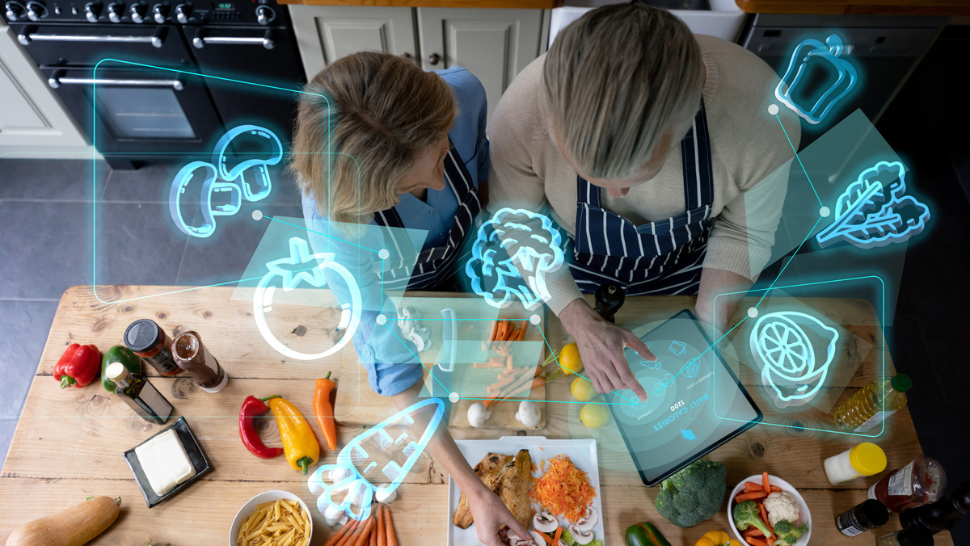
Could the next great flavor combination in your kitchen come from a supercomputer? As artificial intelligence works its way into our lives, a fascinating frontier is emerging: teaching technology how to taste.
Welcome to the world where AI is learning to suggest flavor — where chemistry, data science, and a pinch of culinary magic collide.
How do you teach a machine to taste? Humans experience flavor through a complex interplay of taste, aroma, texture, and memory. AI doesn’t have taste buds (yet), but it can analyze enormous datasets of flavor compounds, ingredient pairings, and seasonal and regional cuisine patterns it has learned from human creation. Using this data, AI models can identify combinations that have traditionally worked, and (maybe) even propose ones that you haven’t tried yet. Some systems rely on chemical compound similarity, pairing ingredients that share volatile aromatic molecules. Others take a more behavioral approach, learning from cookbooks, recipes, and crowd-sourced reviews to identify what humans have historically enjoyed.
The flavor pairing revolution. Companies and research teams have been creating models to suggest flavor compatibility across cultures, design new recipes with unusual pairings, adapt menus to seasonal or regional preferences and palates, and forecast the success of new food products before they hit the market.
For example, AI-driven culinary experiments have surfaced unexpected pairings like strawberries and mushrooms, and cocoa and blue cheese—combinations that sound strange but are chemically justified… at least in theory.
Cross-cultural fusion, powered by data. Culinary fusion isn’t new, but AI is giving it a more systematic edge. By analyzing flavor compounds and cooking patterns across regions, AI can identify why cross-cultural pairings work and suggest thoughtful variations or extensions of combinations that chefs have begun to explore — think miso in a cacio e pepe, kimchi in collard greens, or Gochujang in a Tex-Mex chili. Using familiar ingredients that can be re-imagined through a data-backed lens.
This kind of digital creativity could open doors for more inclusive, globalized menus that push boundaries, while respecting tradition.
But can it really tell YOU what tastes good? Here’s the kicker: flavor isn’t just science. It’s emotion, memory, and context – and highly personal to your history and experiences with food. An algorithm might suggest that durian and Camembert make a perfect match, but your nose might strongly disagree.
All AI “knowledge” starts with humans, and humans will always be the final judges. AI can inform and inspire, help consolidate ideas, and even give you a few minutes back through more streamlined planning, but taste remains a personal, cultural, and evolving experience. In the end, the goal isn’t to replace human chefs; it’s to augment creativity and make the act of eating an even more personalized, adventurous, and delicious experience.
So yes, AI may not “taste” in the traditional sense, but it’s learning to flavor the future, one algorithm at a time.